
How we’re using AI personas to supercharge B2B tech PR
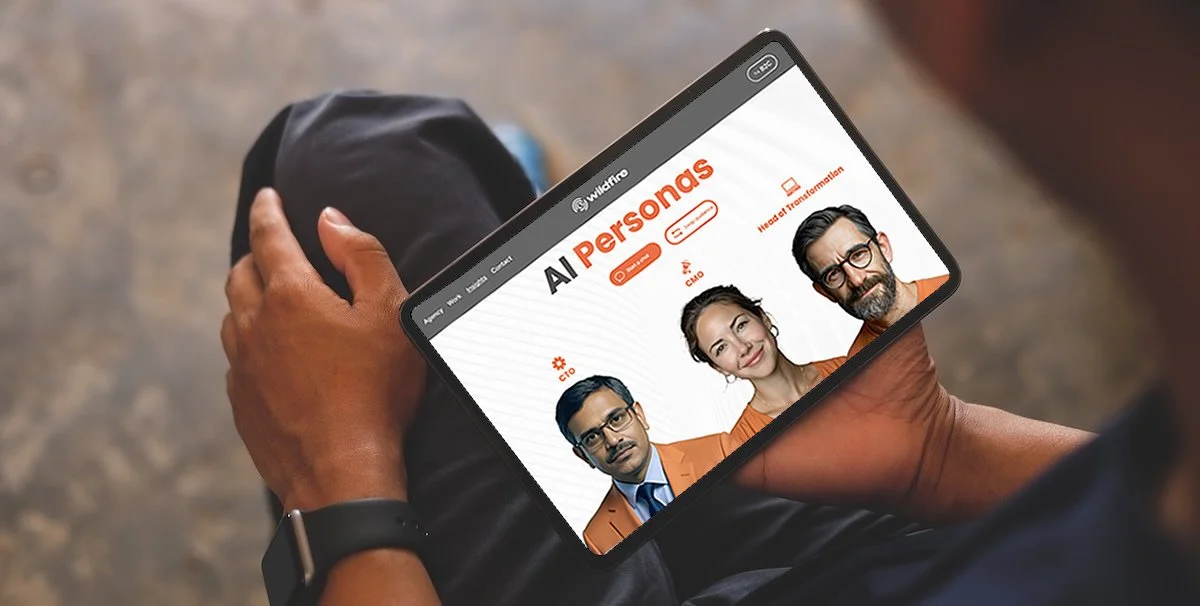
We’ve been on a bit of a recruitment drive lately. Not for more PR professionals (though we’re always open to that), but for a new kind of team member — the synthetic kind.
We’ve now got an expanding cast of virtual colleagues joining our brainstorms and campaign planning sessions: a CTO with decades of experience in the telecoms sector; a Head of Transformation at an NHS trust; a CMO for a fast-growing e-commerce brand; and more.
They’re not real people, of course. They’re AI-generated personas: detailed, behaviourally informed simulations of our clients’ customers and stakeholders. Each one brings a different perspective, helping us test ideas, challenge assumptions, and build communications that actually land in the real world.
Why we’re doing It
One of the biggest challenges in B2B comms is perspective. It’s not easy for a 20- or 30-something PR professional to genuinely get inside the head of a telco CTO, or a senior NHS decision-maker managing transformation under pressure. These are smart, experienced people with complex motivations, and we rarely get the luxury of picking their brains directly.
Traditionally, we’ve relied on a mix of desk research, experience, and good intuition to fill that gap. But now, synthetic personas allow us to bring those perspectives into the room to interrogate, test, and refine our thinking before anything reaches the real world.
Would it be better to do real-world focus groups or first-party research? Of course, but let’s be honest — how often do we have the time or budget for those in PR? Synthetic personas give us a fast, credible way to stress-test and augment thinking before anything reaches the real world.
How it works
For those sceptical about whether this really works, it’s worth explaining that this isn’t just a quick ChatGPT prompt or a generic ‘B2B buyer persona’.
Our synthetic personas are built from a proprietary, multi-dimensional template grounded in behavioural science. We codify the drivers, constraints, habits, and real-world contexts that shape people’s choices, then translate those into structured AI prompts. To this model we add proprietary and public data.
The result is a working model that can be interrogated, challenged, and iterated — helping us uncover which proof points unlock trust and those that trigger prompt action, and which tones of voice reduce friction.
Our resident AI expert Luke Proctor and our AI consultancy partner have gone all KFC and developed what we like to call a “seven-spice blend” — a unique mix of credibility thresholds, motivations, objections, and moments that matter. It’s our secret recipe for building personas that actually think like people, not prompts.
Why it matters
The beauty of these personas is that they never sleep, never go on holiday, and never get stuck in meetings. When a team member wants to bounce around campaign ideas, test a thought, or pressure-test a proof point at any time of day, they’ve got a reliable digital colleague to turn to.
And this is what really excites us about AI. It’s not here to do our jobs for us; it’s here to make us sharper, more creative, and more responsive.
So yes, we’re “actively recruiting” AI team members. But we’re also still hiring real humans — because they’re definitely more fun to go to the pub with.
The future of AI in PR
At Wildfire, we see the role of AI not as a cost-cutter, but as a creativity amplifier. The more we use it to challenge our assumptions and expand our empathy for clients’ audiences, the smarter our work becomes.
If you’re curious about how synthetic personas could sharpen your own marketing or communications, we’d love to share what we’ve learned — from our synthetic recruits and the rest of the (very real) team.
